about SPPAP
Overview
The Southern Punjab Poverty Alleviation Project (SPPAP) is a transformative initiative aimed at reducing poverty in most economically challenged districts of Southern Punjab. Supported by the International Fund for Agricultural Development (IFAD), the project is implemented through a financial agreement between the Government of Pakistan and IFAD. Oversight is provided by the Project Steering Committee (PSC), chaired and administered by the Punjab Planning & Development Board.
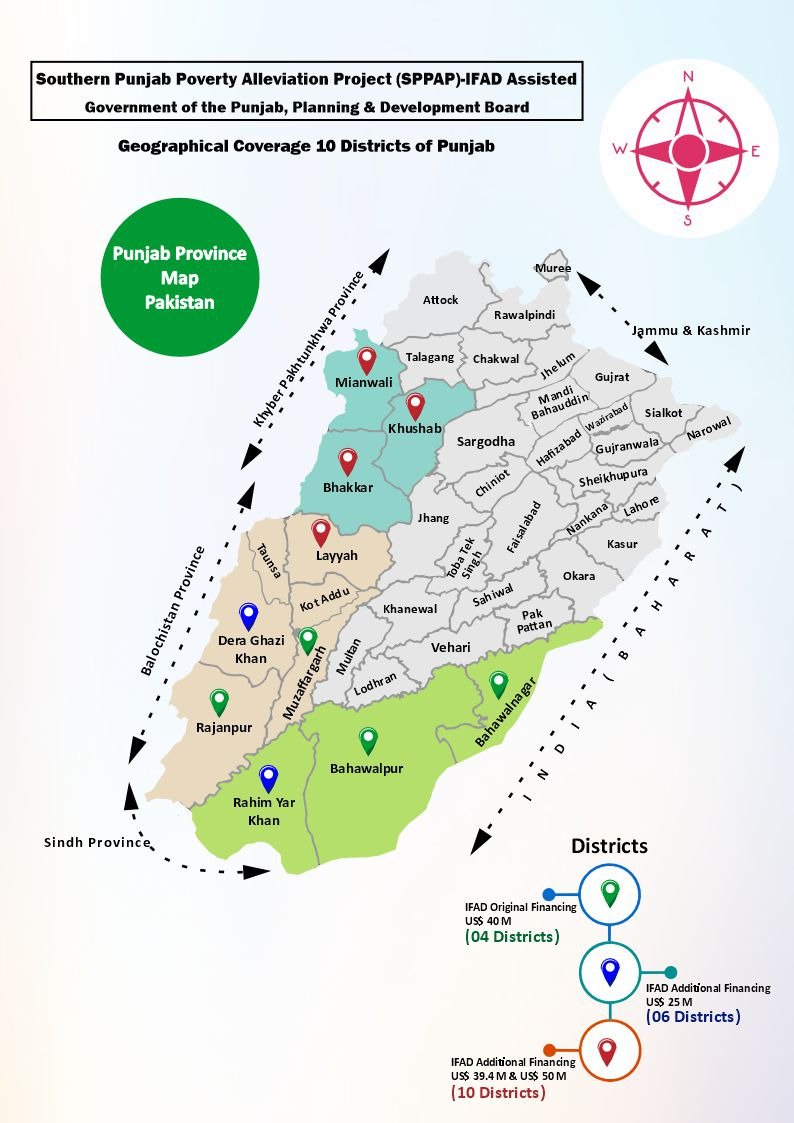
SPPAP operates across ten underprivileged districts, including Bahawalpur, Bahawalnagar, Muzaffargarh, Rajanpur, Rahim Yar Khan, D.G. Khan, Layyah, Bhakkar, Mianwali, and Khushab. Its primary objective is to enhance the incomes and living conditions of 382,823 of the poorest rural households by implementing a diverse range of interventions. These include:
- Asset creation & transfer (small ruminants, land plots, etc.)
- Agricultural & livestock development
- Community infrastructure projects
- Low-cost housing
- Vocational & entrepreneurial training
Through these targeted efforts, SPPAP seeks to boost employment opportunities, increase agricultural productivity, and improve overall living standards.
To ensure efficient execution, SPPAP has established:
- A Project Management Unit (PMU) in Bahawalpur
- A Regional Coordination Unit (RCU) in Layyah
- District Management Units (DMUs) in each of the ten project districts
Community participation is central to the project’s approach. Implementation is carried out through Community Organizations (COs)/Village Organizations (VOs), with support from Social Mobilization Partners such as the National Rural Support Program (NRSP) for beneficiary identification and the Institute of Rural Management (IRM) for vocational training.
SPPAP follows a focused poverty alleviation strategy, leveraging National Poverty Score Card (NPSC) Survey data to identify and assist households in the lowest poverty bands. The project also prioritizes gender inclusion, ensuring women’s participation through designated quotas and direct beneficiary representation.
Current Status
The International Fund for Agricultural Development (IFAD) conducts annual reviews to assess SPPAP’s progress, consistently commending its effectiveness. Over the past seven years, the project has achieved 100% of its physical and financial targets, with an outstanding targeting accuracy in reaching households in the 0-32 poverty quantile (categories 1 & 2).
Since 2015, 440,938 households have benefited from project initiatives—exceeding the original target of 382,823 households. Financially, SPPAP has fully utilized:
- US$ 65 million from the first two loans
- 100% of the US$ 36 million third loan and US$ 2.9 million grant,
- 45% of the US$ 50 million
As of June 2025, progress toward the reporting fiscal year’s targets stands at 100%, with the project expected to achieve all remaining goals within the stipulated timeframe.
With its strategic approach, strong governance, and community-driven model, SPPAP continues to make a significant impact in alleviating rural poverty across Southern Punjab.
Area of operations & Activities
SPPAP operates across ten underprivileged districts, including Bahawalpur, Bahawalnagar, Muzaffargarh, Rajanpur, Rahim Yar Khan, D.G. Khan, Layyah, Bhakkar, Mianwali, and Khushab (New Additional Financing).
Its primary objective is to enhance the incomes and living conditions of 382,823 of the poorest rural households by implementing a diverse range of interventions.
Objective
The main objective of the project is to increase incomes of (80,000+51,000=131,000) poor households by enhancing the employment potential of the people and increasing agriculture productivity and production through:-
- Assets Transfer
- Vocational/Entrepreneurship Trainings.
- Productivity Enhancement Initiatives.
- Small Scale Community Physical Infrastructure (CPI) Schemes.
- Low Cost Housing For Poor Women.
- Revolving Fund for Agriculture, Enterprise and Livestock Development
Components
- Livelihood Enhancement
- Agriculture & Livestock Development
- Project Management
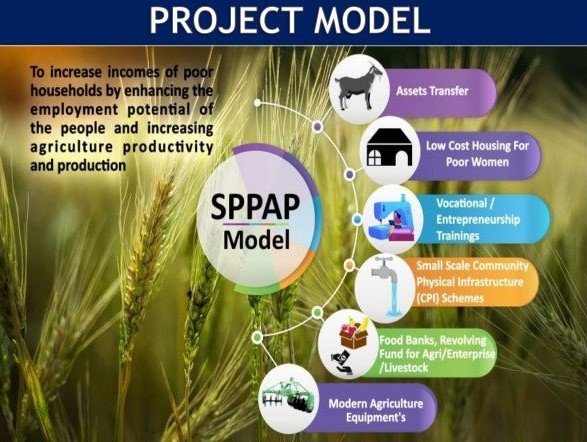
To increase income of poor households by enhancing the employment potential of the people and increasing agriculture productivity and production.
key points of project model
- Assets Transfer
- Low Cost Housing For Poor Women.
- Vocational/Entrepreneurship Trainings.
- Small Scale Community Physical Infrastructure (CPI) Schemes.
- food banks, Revolving Fund for Agriculture, Enterprise and Livestock.
- modern agriculture equipment's.
Project Targeting Approach
Project is using three targeting approaches;
- Geographical targeting
- Household/Poverty Targeting
- Gender Targeting